Questions & answers
Quick answers to the questions we hear most.
Why does it say “Unlikely” when Kp is high?
Kp measures how active the aurora is around the whole planet. The Tonight card answers a narrower question: will you see it, where you are, in the next few hours? It combines four things:
- Activity at your latitude. Each place needs a certain Kp before the aurora reaches it. A place at 55° magnetic latitude needs about Kp 4, and one further from the pole needs more.
- Darkness. The aurora can't be seen in daylight or bright twilight.
- Cloud. Thick cloud hides it, however strong it is.
- The Moon. A bright Moon washes out fainter displays.
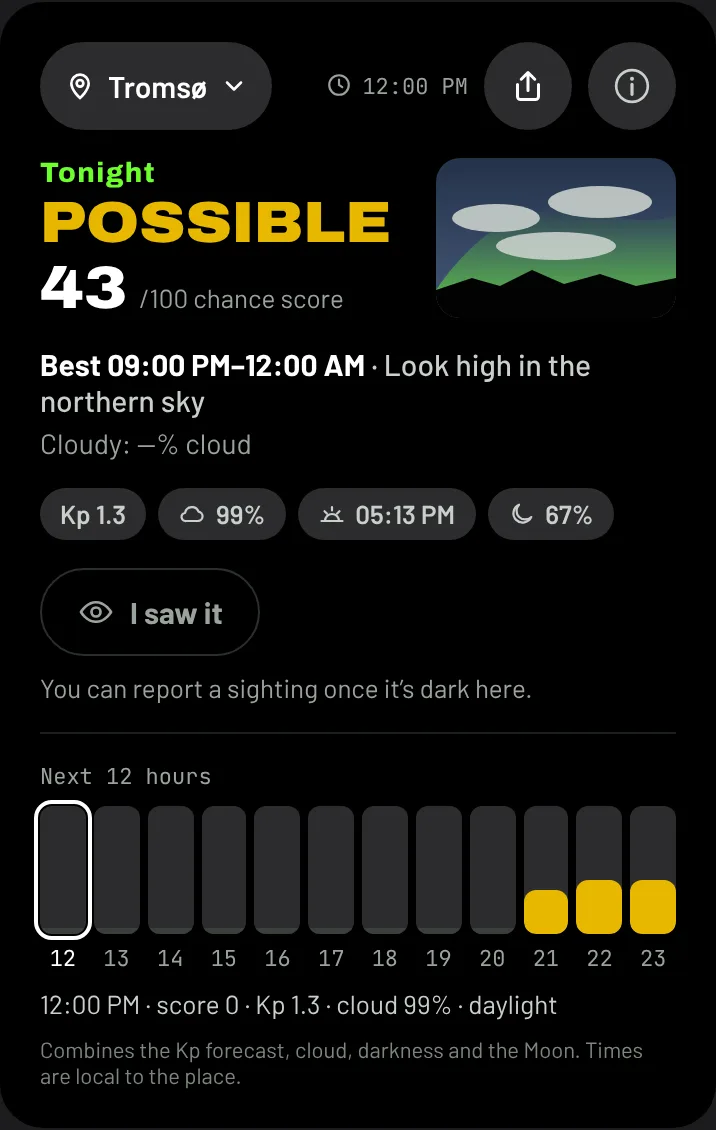
The line under the verdict names the main reason, such as Activity too low, Too light, Cloudy or Bright Moon. Check the Next 12 hours bars on the same card: a better hour later in the night is often shown there.
Why can't I report a sighting yet?
The I saw it button on the Tonight card works when:
- It's dark at the place shown on the card. Until then it says You can report a sighting once it's dark here.
- You're signed in. Reports are linked to your account so they can count towards your badges.
- You haven't reported in the last 12 hours. One report covers a whole night.
Reports appear on the map for 3 hours, without anything that identifies you, and help other members nearby.
When do my badges and points appear?
A sighting is checked about an hour after you report it, so that others nearby have had time to report too. It counts when either:
- another member reported aurora within 50 km and an hour of you, or
- NOAA's OVATION forecast showed at least a 10% chance of aurora near you.
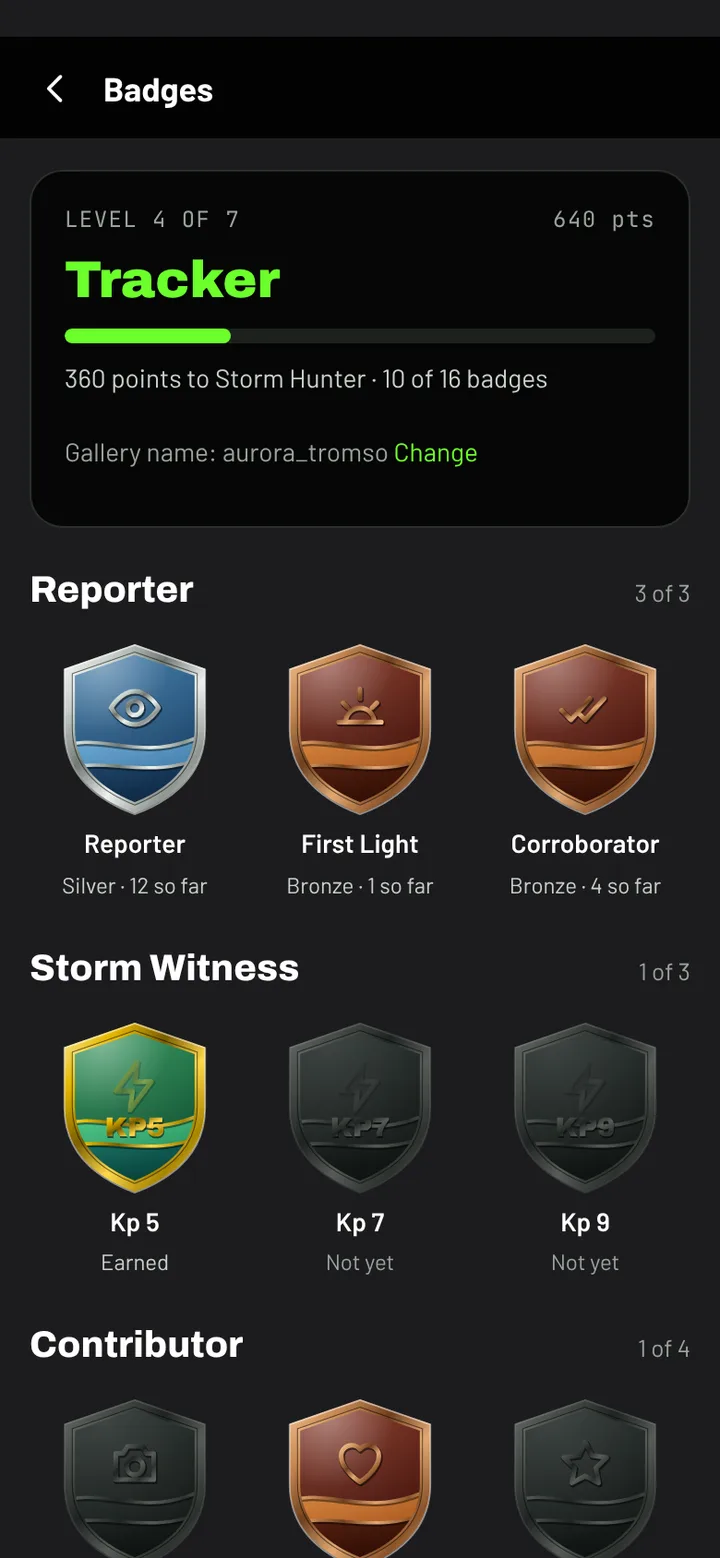
Confirmed reports earn points and badges. Checks run every 15 minutes, and a New badge message appears the next time you open Polar Lights. Your badges and rank are under You → Badges.
Can other people see my location?
- Saved locations are private to your account. Only you see them.
- Sightings appear on the map for 3 hours at a position rounded to about 10 km, with nothing that identifies you. They're deleted after 30 days.
- Gallery photos show the place only as precisely as you choose when posting: a town (to about 10 km), a wider area, or no place at all. Location data stored inside the photo file is removed before upload.
The privacy policy explains everything we store and why.
How do I cancel Chaser?
Paid by card (on the website)
On a phone, open You → Plan & billing. On a computer, open Dashboard → Account. Then choose Manage billing or Cancel membership. Stripe's secure billing page opens, where you can cancel; it shows the date your membership ends.
Paid through Google Play
Open You → Plan & billing and choose Manage in Google Play. Or, in the Play Store app, tap your profile picture, then Payments & subscriptions → Subscriptions → Polar Lights → Cancel subscription.
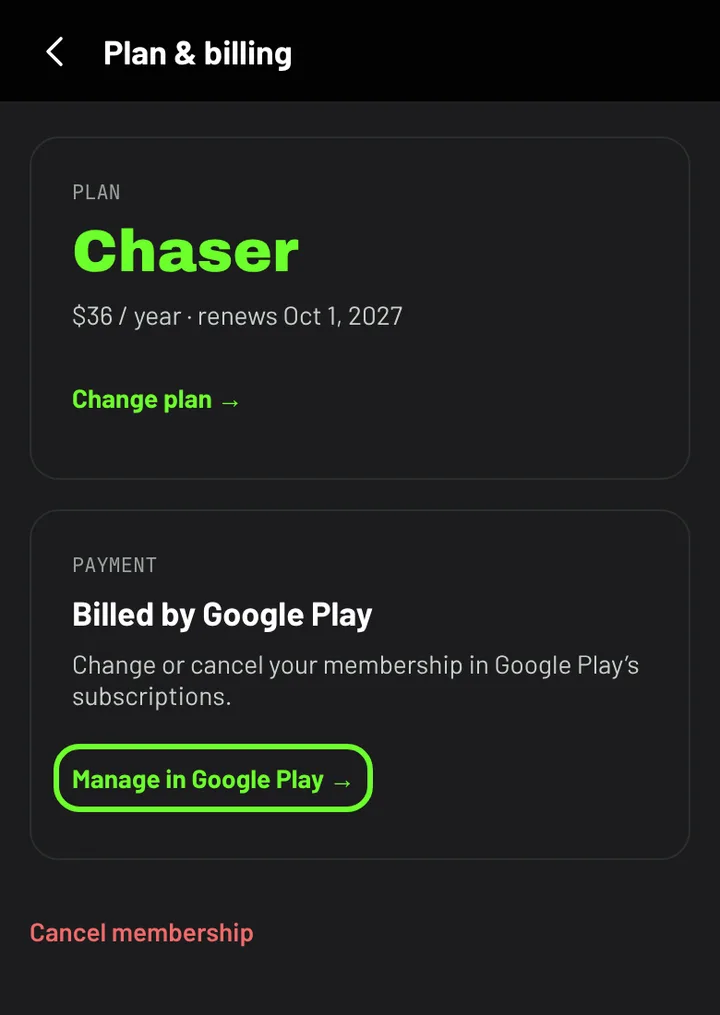
Deleting your account also cancels a card subscription straight away, and stops a Google Play subscription from renewing.
How do I delete my account or some of my data?
- In the Android app: open You and choose Delete account at the bottom.
- On the website: sign in and open Dashboard → Account, then choose Delete my account.
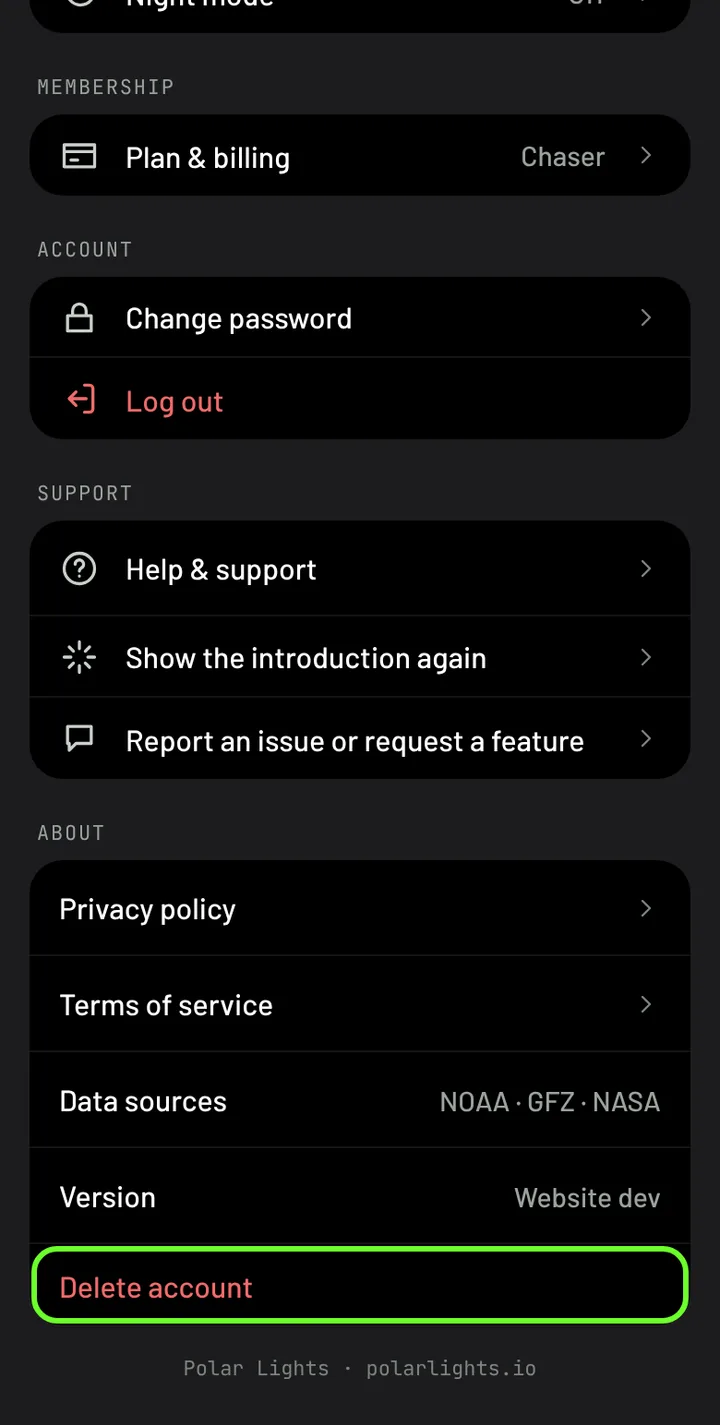
Your account and its data are deleted straight away and you're signed out. You can also keep your account and remove only some data: saved locations, gallery photos or alerts. Delete your account explains how, what else you can ask us to remove, and exactly what is deleted.
Does Polar Lights work in the southern hemisphere?
Yes. The southern lights (aurora australis) follow the same rules as the northern lights. The Tonight verdict, the chance score, alerts and saved locations all work for southern places, using your distance from the southern magnetic pole.
The small map on the Now page shows the northern oval. When your place is in the southern hemisphere it says so under the map.
Why are some Sun images an hour old?
The Sun views come straight from NASA's SDO, the ESA/NASA SOHO mission and NOAA's GOES-19 and SWFO-L1 spacecraft. Each publishes new images on its own schedule:
- SDO images are usually less than an hour old.
- SOHO's LASCO coronagraphs often lag by an hour or more.
- NOAA's SUVI and CCOR images update every few minutes to every 15 minutes.
The time printed on each image is when it was taken, in Universal Time (UT). The time-lapse saves one image of each view every hour.